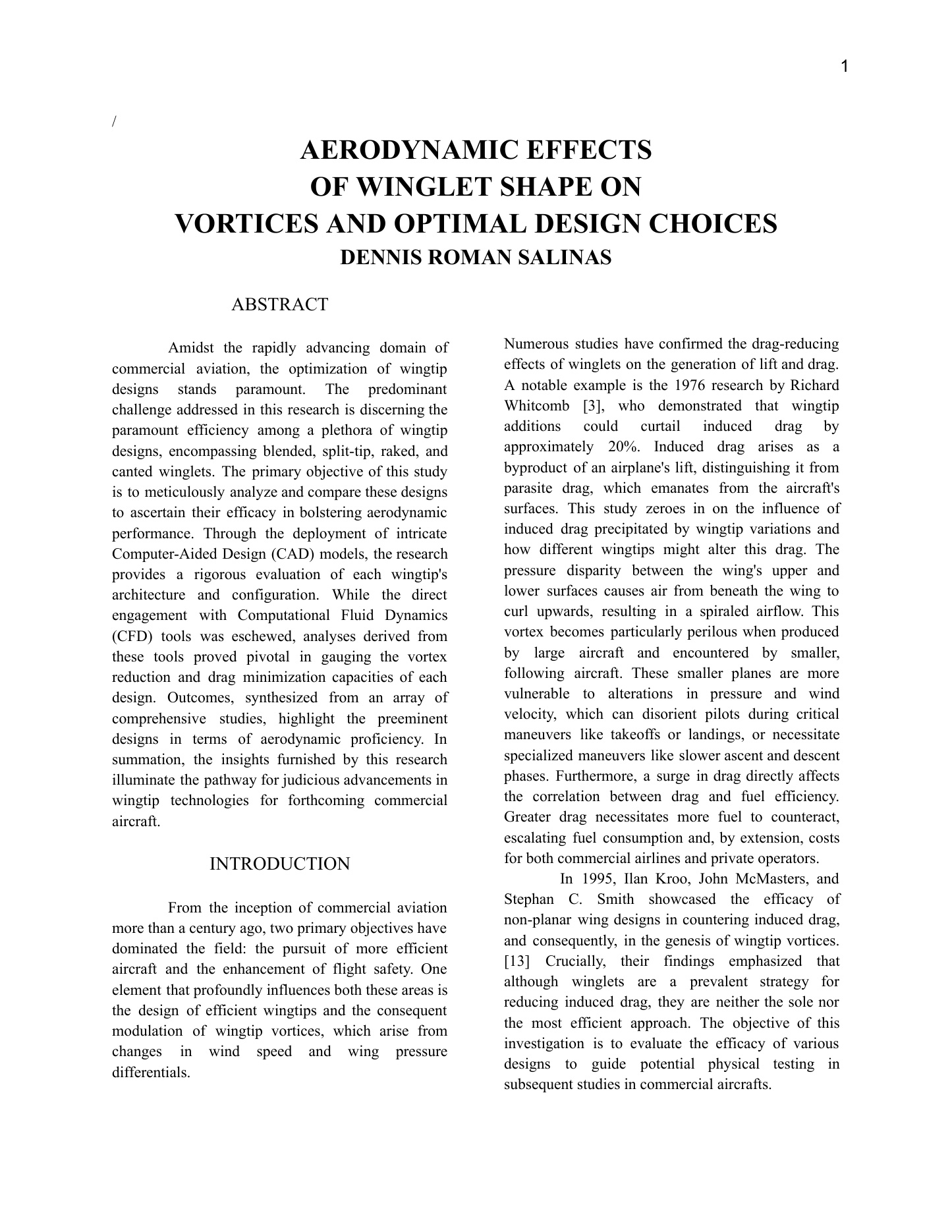
Report title page from the high school winglet study.
Snapshot
- Project type: High school independent aerodynamics research
- Institution context: Colegio San José de Río Piedras
- Timeline: October 2023 to May 2024
- Important scope note: I did not run the CFD simulations myself in this project; I analyzed published CFD outputs and related data.
Objective
- Compare how different winglet families influence induced drag, vortex behavior, and practical aircraft performance.
- Distill a large set of references into engineering-useful guidance for design selection.
- Balance aerodynamic gains with real-world implementation constraints.
Method used
- Performed historical analysis of major winglet evolution in commercial aviation.
- Reviewed CAD model descriptions and geometry conventions from published studies.
- Synthesized CFD-based findings from literature across:
- Lift-to-drag trends
- Vortex clustering/dispersion behavior
- Angle-of-attack and Reynolds-number sensitivity
- Mapped findings to operational considerations (range, endurance, manufacturability, airport constraints).
Key findings from the high school paper
- No single winglet is universally optimal across all mission profiles.
- Blended and split-tip concepts show strong vortex-management advantages in many use cases.
- Raked wingtips can improve endurance/range in long-haul oriented scenarios by aspect-ratio effects.
- Variable-cant/canted concepts appear promising for adaptable multi-condition performance.
What this project demonstrates
- Early technical maturity in reviewing and synthesizing aerospace CFD literature.
- Ability to write decision-oriented engineering documentation with evidence traceability.
- Strong foundation that later transitioned into hands-on CFD-heavy projects at college level.
Source document
- PDF used for this entry:
Aerodynamic Effects of Winglet Shape (1).docx (1).pdf